
The essentials in 30 seconds
Five changes introduced by decree 640.26, signed on 26 March 2026 by the Minister of Transport and Logistics and published on 3 August 2026 in Bulletin officiel n°7531. The text amends and completes decree 2711.10 of 29 September 2010, which had defined the format in effect until now. It is the deepest overhaul of the Moroccan registration regime since the central-Arabic-letter format was introduced in the early 2000s.
- Unified plate for national and international use. End of the two-tier system where the local plate was completed by a separate blue "MA" strip added before crossing a border.
- Arabic letter systematically paired with a Latin equivalent in the body of the plate, so foreign authorities and ANPR systems can read it immediately.
- "MA" mark integrated directly into the plate itself — no more separate oval sticker to add before travelling.
- Standardised dimensions across every Moroccan plate (cars, LCVs, motorcycles), for uniform legibility and easier manufacturing.
- New format for two-wheelers (motorcycles, tricycles, light quadricycles), sized 180 × 200 mm, effective 1 January 2027.
What actually changes on the plate
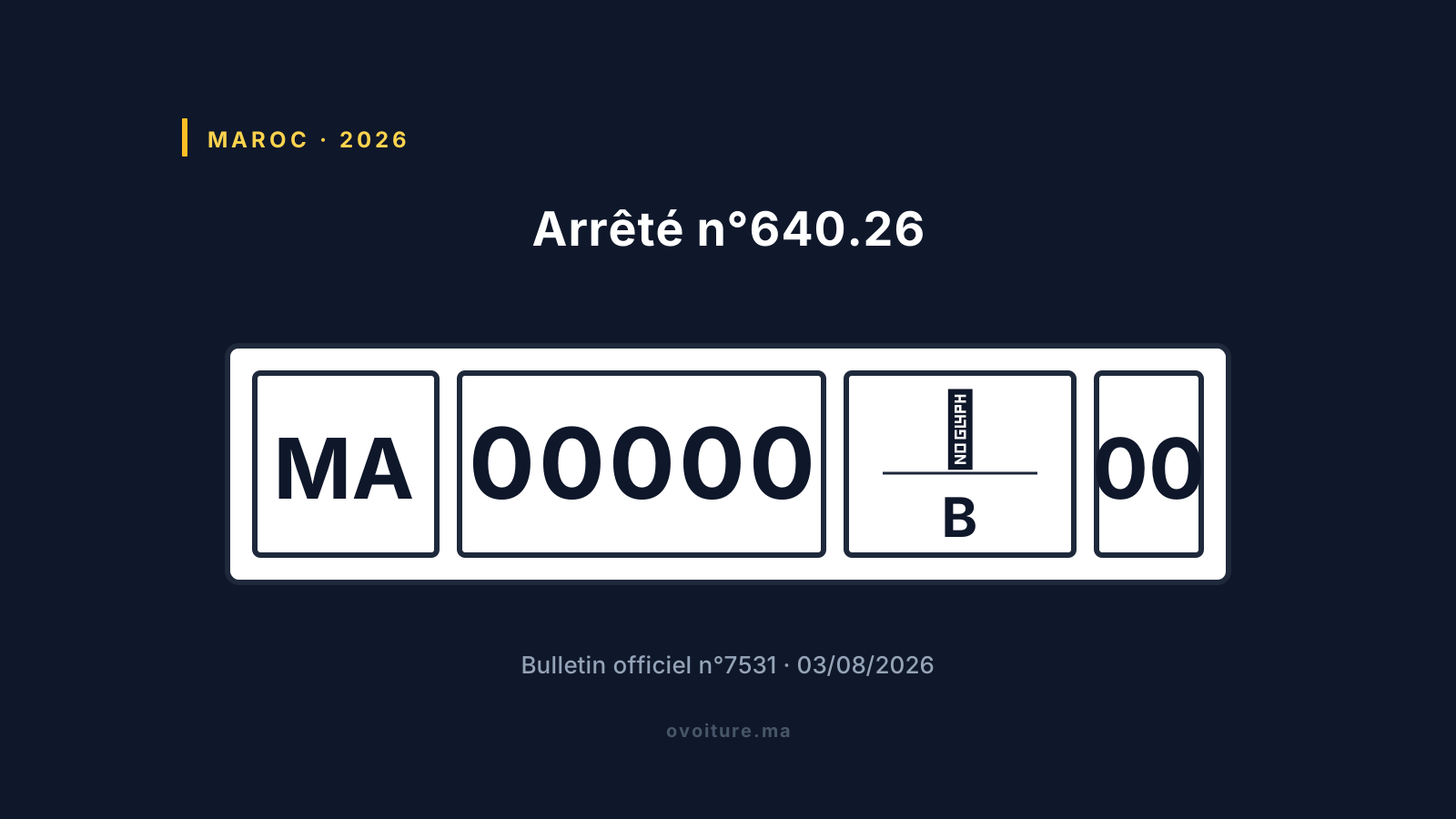
The historical Moroccan format — five digits, one Arabic letter (أ, ب, ج…), the prefecture code (1 to 89) — stays structurally intact: what moves is what surrounds it. The central Arabic letter is now flanked by its Latin equivalent (A, B, J…), printed next to it or below depending on the dimensions. The "MA" mark (for Morocco) is integrated on the left of the plate, in a dedicated strip that functionally replaces the old oval sticker drivers used to buy when travelling abroad.
In practice, a new-format plate looks like this: `[MA] | 12345 | أ / A | 7`. Reading is immediate for any police officer, customs agent or automated recognition system, whether they're in Rabat, Algeciras or Barcelona. This addressed one of the long-standing complaints about the 2000 format: abroad, the central Arabic letter created data-entry problems in enforcement systems, forcing Moroccan drivers into repeated explanations at European border crossings.
The background colours (white for private vehicles, black for state cars, yellow for taxis, blue for auxiliary forces, and so on) are preserved. The 1-89 prefecture codes too. Diplomatic (CC/CD), official (96-99), military and police plates keep their specific formats. The reform therefore touches the ordinary civilian plate — yours, if you drive a private vehicle.
Who has to change plates and when
This is the most frequent practical question since the text was published. The answer depends on three things: which plate you have today, whether you plan to leave Morocco, and when your next registration act (transfer, import, renewal) is likely to happen.
- You have an ordinary plate (digits + Arabic letter only), national use only: no immediate obligation to change. You can keep driving on your current plate until the next transfer of ownership — i.e. when you sell the vehicle. NARSA has explicitly ruled out a mass recall to avoid overwhelming counters and to spare households the cost.
- You have a plate with a separate "MA" strip for international travel (MREs, cross-border hauliers): you have until 31 December 2026 to switch to the new unified format. After that date, your old plate + separate MA strip combination will no longer be recognised at border crossings. The new format becomes mandatory for any border passage.
- You're registering a new vehicle (dealer purchase) or importing a vehicle (used car from Europe / Gulf): the new format is applied automatically since 3 August 2026. No choice — that's what you'll receive.
- You ride a two-wheeler (motorcycle, tricycle, light quadricycle): the new 180 × 200 mm format becomes mandatory on 1 January 2027 for any new registration. Existing plates remain valid under the same rules as for cars (rolling replacement at the next transfer).
Registering a new or imported vehicle — the 2026 procedure
Since 2024, most registration paperwork is digitised through the official tasshilat.ma platform, run by NARSA. Physical appointments at the Regional Transport Directorate (DRT) remain possible via rendez-vous.narsa.ma but have become residual — an estimated 95 % of files are now handled online. The digital service covers initial registration (new vehicles), transfer (used-car purchase), duplicates, change of address, and renewal.
For a new vehicle bought from a Moroccan dealer (Renault Maroc, Auto Nejma, Auto Hall for Mercedes, Peugeot Maroc, and so on), the dealer files the paperwork on your behalf. You receive the PDF registration document within 24 to 72 hours, and the official plastic card by registered mail within 7 to 15 days. Plates (in the new 640.26 format) are ordered from an approved manufacturer — the dealer either points you to one or supplies them directly depending on the brand.
For a vehicle imported from Europe (private purchase in France, Belgium, Spain, Germany — the classic MRE route), the documents to provide are: original title (European carte grise), customs declaration (form D8 with duties paid — eco vignette + TIC + VAT depending on fiscal HP and age), Moroccan roadworthiness certificate, registration form, provisional insurance contract. The vehicle circulates on a WW transit plate (valid 45 days, renewable once) while the file is processed, then receives its permanent plate in the 640.26 format.
Transferring ownership of a used vehicle
Ownership transfer — the change of registered keeper on the sale of a used vehicle — is the main trigger for the switch to the new format for most Moroccans. Every time a vehicle changes hands, the plate is re-issued in the format in effect that day. In other words: your neighbour who sells a Dacia Logan to a third party in September 2026 will see the buyer drive away with new plates in the 640.26 format, even though the vehicle was previously running on the old one.
The procedure is fully digitised on tasshilat.ma: upload of the signed and legalised sale contract, the seller's registration document, the "non-gage" certificate (free online), the roadworthiness certificate in force (under 6 months old), and the proof of payment of the transfer tax (scale based on fiscal HP, roughly 250 to 2,500 MAD). Allow 5 to 10 working days to receive the new registration card and the new plates.
We detail the full procedure, exact documents, fee schedule by fiscal HP and pitfalls to avoid in our dedicated guide Transferring a Moroccan carte grise.
Two-wheelers and light quadricycles — new format 1 January 2027
The overhaul also covers motorcycles of every displacement, tricycles and light quadricycles (unlicensed microcars such as Aixam / Ligier). The new standard format is fixed at 180 × 200 mm, considerably larger and more legible than the mini-plates historically used on some older bikes. The structure follows the car logic: prefecture code | series (1 to 99) | serial number (up to 99,999).
Entry into force for two-wheelers is set at 1 January 2027 — a five-month buffer after publication that gives approved manufacturers time to retool their presses to the new format, and importers (Aprilia, CFMoto, KTM, Harley-Davidson, Sym, etc.) time to align deliveries. A new bike registered after that date will automatically receive the new format; bikes already on the road stay on their current plate until the next transfer.
International travel — MREs, hauliers, border crossings
For the MRE community (Moroccans living abroad) and road hauliers who cross borders regularly, the date to remember is 31 December 2026. After that day, any Moroccan vehicle circulating abroad must carry the new unified format — plate embedding the "MA" mark and adjoining Latin letter. The old "national plate + separately-stuck MA strip" arrangement will no longer be accepted at European border posts or by ANPR (automated plate recognition) systems, which are being deployed increasingly widely in Spain, France and Italy.
Practically, if you're an MRE and plan to drive down to Morocco in summer 2027, schedule the switch to the new plate before your 2027 summer trip (or right now if you're coming back to Morocco during autumn or winter 2026-2027). The process can be initiated online from abroad via tasshilat.ma; the physical plate collection happens on your arrival in Morocco, at the DRT of your registration prefecture. Some approved manufacturers also offer postal shipment, subject to conditions.
Cost and fines — what to expect
Plate replacement alone, without changing the registration document, costs around 200 to 300 MAD for the pair (front + rear) from an approved manufacturer — the tariff has not been revised by decree 640.26 itself, which only touches the format, not the tax schedule. If the replacement is combined with a transfer of ownership, the usual transfer fees apply on top (250 to 2,500 MAD depending on fiscal HP). Initial registration (new or imported vehicle) is still billed under the standard NARSA scale, detailed in our guide Moroccan carte grise — fees by fiscal HP.
On enforcement, the Moroccan highway code already provides fines for non-compliant plates (wrong font, damaged plate, obstructed by mud, non-homologated retro-reflection) of 300 to 700 MAD depending on severity. These fines remain applicable and will apply naturally, after the grace periods above, to any old-format plate that should have been replaced. No "retroactive" fine is provided for by decree 640.26 — owners have the official grace periods to bring themselves into compliance.
Going deeper on the Moroccan plate
The 640.26 reform changes the format but doesn't touch the fundamentals: plate anatomy (digits, letter, prefecture code), the 89-prefecture code list, colours by category (private, state, taxi, diplomatic, WW), and edge cases (W18 test plates, garage plates) remain identical. We cover the whole thing in detail in our Complete guide to the Moroccan license plate, updated to reflect the reform.