
Updated · August 2026
New Moroccan license-plate format — decree 640.26
Unified national and international plate, Latin letter alongside the Arabic one, embedded "MA" mark: the deepest reform since 2000, published on 3 August 2026 in Bulletin officiel n°7531.
Read the dedicated article →
Official guide · Updated 2026
Moroccan license plates — Format, regional codes and colours
Everything about Moroccan license plates: full format, meaning of numbers and letters, prefecture codes, colour categories, WW series for imported vehicles, replacement procedure.
The essentials in 30 seconds
A standard Moroccan license plate follows the format NNNNN-X-CC, where NNNNN is a sequential serial (1 to 99,999), X is an Arabic letter identifying the series, and CC is the prefecture code (1 to 99). Example: 12345 - أ - 7 means "plate #12345 of series أ, registered in Oujda (prefecture 7)".
Black plates on a white background are standard for private vehicles. Red identifies state vehicles, blue the Auxiliary Forces, yellow taxis and heavy commercials. The WW series marks imported vehicles awaiting permanent registration.
2026 reform — in brief
Decree n°640.26, published on 3 August 2026 in Bulletin officiel n°7531, introduces a new Moroccan plate format. Five changes: the plate now embeds the "MA" mark (end of the separate blue sticker), the central Arabic letter is paired with its Latin equivalent, dimensions are standardised, one single plate is valid for both national and international use, and a new 180 × 200 mm format applies to two-wheelers from 1 January 2027.
Good news: no mass recall. Ordinary national plates remain valid until your next ownership transfer. The only hard deadline: 31 December 2026 for vehicles equipped with a separate "MA" strip for international travel (MREs, hauliers). New registrations (new or imported vehicles) receive the new format automatically since 3 August 2026.
Regulation
The new Moroccan plate format
One single format, at home and abroad
Applicable since 3 August 2026 · Decree n°640.26 · Bulletin officiel n°7531
Anatomy of a Moroccan plate
Three elements make up a standard Moroccan license plate, read right-to-left in the Arabic version (left-to-right in the international Latin version).
12345
أ
7
Serial number
From 1 to 99,999, assigned sequentially to each registration in the current series.
Arabic letter
Identifies the current "series" for that prefecture. Once a series is exhausted, it moves to the next letter of the alphabet.
Prefecture code
From 1 to 99, identifies the prefecture or province of registration. Defines where the vehicle was originally registered.
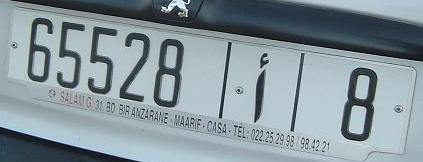
The Arabic letters used
Moroccan plates use the letters of the Arabic alphabet in order, except for a few reserved or avoided letters. When a series reaches 99,999 vehicles, the next letter is used.
Letters typically used (alphabetical order): أ، ب، ج، د، هـ، و، ز، ح، ط، ي، ك، ل، م، ن، س، ع، ف، ص، ق، ر، ش، ت، ث، خ، ذ، ض، ظ، غ.
Three letters carry a special meaning: ج historically reserved for state vehicles before the red colour was generalised, ر sometimes used for official vehicles, م reserved for military vehicles.
Codes for the main prefectures
The 1- or 2-digit code at the end of the plate identifies the prefecture (or province) where the vehicle was originally registered. These are the most common codes — the full official list is on narsa.ma and may evolve with administrative restructuring (notably since the 2015 Régionalisation Avancée).
| Code | City / Prefecture | Region |
|---|---|---|
| 1 | Rabat | Rabat-Salé-Kénitra |
| 2 | Salé | Rabat-Salé-Kénitra |
| 3 | Sala Al Jadida | Rabat-Salé-Kénitra |
| 4 | Skhirat-Témara | Rabat-Salé-Kénitra |
| 5 | Khémisset | Rabat-Salé-Kénitra |
| 6 | Casablanca-Anfa | Casablanca-Settat |
| 7 | Casablanca-Aïn Sebaâ | Casablanca-Settat |
| 8 | Casablanca-Hay Hassani | Casablanca-Settat |
| 9 | Casablanca-Ben M'sick | Casablanca-Settat |
| 10 | Casablanca-Moulay Rachid | Casablanca-Settat |
| 11 | Casablanca-Al Fida | Casablanca-Settat |
| 12 | Casablanca-Mechouar | Casablanca-Settat |
| 13 | Casablanca-Sidi Bernoussi | Casablanca-Settat |
| 14 | Mohammédia | Casablanca-Settat |
| 15 | Fès-Jdid | Fès-Meknès |
| 16 | Fès-Médina | Fès-Meknès |
| 17 | Fès-Zouagha Moulay Yacoub | Fès-Meknès |
| 18 | Sefrou | Fès-Meknès |
| 19 | Boulemane | Fès-Meknès |
| 20 | Meknès-Al Menzeh | Fès-Meknès |
| 21 | Meknès-Ismaïlia | Fès-Meknès |
| 22 | El Hajeb | Fès-Meknès |
| 23 | Ifrane | Fès-Meknès |
| 24 | Khénifra | Béni Mellal-Khénifra |
| 25 | Errachidia | Drâa-Tafilalet |
| 26 | Marrakech-Ménara | Marrakech-Safi |
| 27 | Marrakech-Médina | Marrakech-Safi |
| 28 | Marrakech-Sidi Youssef Ben Ali | Marrakech-Safi |
| 29 | Marrakech-Al Haouz | Marrakech-Safi |
| 30 | Chichaoua | Marrakech-Safi |
| 31 | Kelâat Es-Sraghna | Marrakech-Safi |
| 32 | Essaouira | Marrakech-Safi |
| 33 | Agadir-Ida Outanane | Souss-Massa |
| 34 | Inezgane-Aït Melloul | Souss-Massa |
| 35 | Chtouka-Aït Baha | Souss-Massa |
| 36 | Taroudant | Souss-Massa |
| 37 | Tiznit | Souss-Massa |
| 38 | Ouarzazate | Drâa-Tafilalet |
| 39 | Zagora | Drâa-Tafilalet |
| 40 | Tanger-Asilah | Tanger-Tétouan-Al Hoceïma |
| 41 | Tanger-Fahs Anjra | Tanger-Tétouan-Al Hoceïma |
| 42 | Larache-Ksar El Kébir | Tanger-Tétouan-Al Hoceïma |
| 43 | Chefchaouen | Tanger-Tétouan-Al Hoceïma |
| 44 | Tétouan | Tanger-Tétouan-Al Hoceïma |
| 45 | Al Hoceïma | Tanger-Tétouan-Al Hoceïma |
| 46 | Taza | Fès-Meknès |
| 47 | Taounate | Fès-Meknès |
| 48 | Oujda-Angad | Oriental |
| 49 | Berkane | Oriental |
| 50 | Nador | Oriental |
| 51 | Taourirt | Oriental |
| 52 | Jerada | Oriental |
| 53 | Figuig | Oriental |
| 54 | Safi | Marrakech-Safi |
| 55 | El Jadida | Casablanca-Settat |
| 56 | Settat | Casablanca-Settat |
| 57 | Khouribga | Béni Mellal-Khénifra |
| 58 | Benslimane (Bouznika) | Casablanca-Settat |
| 59 | Kénitra | Rabat-Salé-Kénitra |
| 60 | Sidi Kacem | Rabat-Salé-Kénitra |
| 61 | Béni Mellal | Béni Mellal-Khénifra |
| 62 | Azilal | Béni Mellal-Khénifra |
| 63 | Smara | Laâyoune-Sakia El Hamra |
| 64 | Guelmim | Guelmim-Oued Noun |
| 65 | Tan-Tan | Guelmim-Oued Noun |
| 66 | Tata | Souss-Massa |
| 67 | Assa-Zag | Guelmim-Oued Noun |
| 68 | Laâyoune | Laâyoune-Sakia El Hamra |
| 69 | Boujdour | Laâyoune-Sakia El Hamra |
| 70 | Oued Ed-Dahab | Dakhla-Oued Ed-Dahab |
| 71 | Aousserd | Dakhla-Oued Ed-Dahab |
| 72 | Casablanca-Aïn Chock | Casablanca-Settat |
| 73 | Nouaceur | Casablanca-Settat |
| 74 | Médiouna | Casablanca-Settat |
| 75 | M'diq-Fnideq | Tanger-Tétouan-Al Hoceïma |
| 76 | Driouch | Oriental |
| 77 | Guercif | Oriental |
| 78 | Ouazzane | Tanger-Tétouan-Al Hoceïma |
| 79 | Sidi Slimane | Rabat-Salé-Kénitra |
| 80 | Midelt | Drâa-Tafilalet |
| 81 | Berrechid | Casablanca-Settat |
| 82 | Sidi Bennour | Casablanca-Settat |
| 83 | Rehamna (Benguerir) | Marrakech-Safi |
| 84 | Fquih Ben Salah | Béni Mellal-Khénifra |
| 85 | Youssoufia | Marrakech-Safi |
| 86 | Tinghir | Drâa-Tafilalet |
| 87 | Sidi Ifni | Guelmim-Oued Noun |
| 88 | Tarfaya | Laâyoune-Sakia El Hamra |
| 89 | Lagouira | Dakhla-Oued Ed-Dahab |
This list covers the codes most frequently seen on Moroccan plates. For the exhaustive and up-to-date list of all 99 prefectures, contact NARSA or your Regional Transport Directorate.
Colour codes by vehicle category
The colour of the plate (and background) lets you instantly identify the vehicle's usage category.
| Colour | Category |
|---|---|
| Black on white | Private vehicles (the vast majority) |
| Red on white | State, government, and municipal vehicles |
| Blue on white | Auxiliary Forces |
| Black on yellow | Taxis, public transport, heavy commercials |
| Green on white | Agricultural vehicles, tractors |
| WW plate | Imported vehicles awaiting permanent registration |
International circulation format
For international travel (transit, customs, border crossings), the Arabic letter in the middle of the plate is duplicated by its Latin uppercase equivalent below it. This convention lets Moroccan-registered vehicles be read without ambiguity by foreign authorities and automated number-plate recognition systems.
State, police, military and diplomatic plates
Several categories of official vehicles carry plates distinct from the civilian format. The main types:
State civilian vehicles
Six digits in white on a black background. The mark 'M' or 'المغرب' (al-Maghrib, Morocco) appears in red at the right edge. For vehicles belonging to local authorities, the red mark is replaced by the Arabic letter ج (jīm).
Police
Plates carry the Arabic letter ش (shīn), short for الشرطة (ash-shurṭa, 'police').
Honorary consuls
Plates bearing the letters 'CC' in red, standing for 'Corps Consulaire' (Consular Corps).
Ambassadors and diplomatic corps
Blue plate bearing the letters 'CD', standing for 'Corps Diplomatique' (Diplomatic Corps).
Foreign cooperants posted in Morocco
Special format combining a number and a mission code, issued by the Ministry of Foreign Affairs.
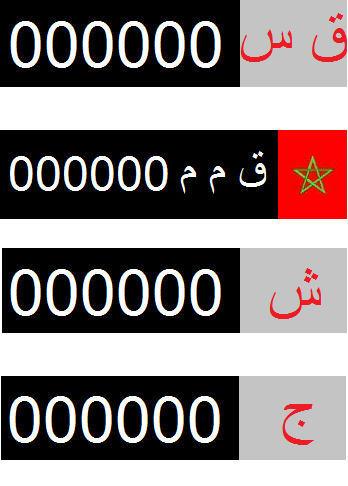
Official codes (96-99): ministers, parliament, royal court
Vehicles of the highest officials carry plates composed of two numbers in black on a white background. The number on the right identifies the holder’s function:
| Code | Function |
|---|---|
| 96 | Official cars of senior officials (walis, governors) |
| 97 | Official cars of the royal court |
| 98 | Official cars of the Parliament |
| 99 | Official cars of ministers |
The WW series — temporary imported vehicles
The WW series (two Latin Ws followed by a number) is assigned to imported vehicles not yet permanently registered — typically used vehicles freshly cleared through customs and waiting for their first Moroccan carte grise.
WW plate validity is limited: 45 days, renewable once, after which the vehicle must obtain a permanent Moroccan registration (standard registration procedure at the Regional Transport Directorate). Driving with an expired WW exposes you to a fine and vehicle impoundment.
W18 is a variant of the provisional series used for new vehicles undergoing testing, or vehicles being serviced by a professional that must temporarily circulate before or during their workshop visit. Validity is limited and strictly tied to the declared test situation.
Damaged, illegible or lost plate
For a damaged plate (impacts, oxidation, loose rivets) or stolen, you must replace it through an approved manufacturer. The procedure doesn't require visiting NARSA if the registration stays the same: the manufacturer makes a new plate matching your carte grise upon presentation.
Indicative cost: 150 to 300 MAD for a pair of plates (front + rear) depending on the material (standard aluminum or premium acrylic). Time: 1 to 3 days at most manufacturers. For a stolen plate, file a police report before replacement — the receipt serves as provisional proof during fabrication.
A brief history of Moroccan plates
The modern registration system in Morocco dates from 1913, under the French protectorate, with a format modeled on the French system of the time. After independence in 1956, Morocco maintained a hybrid system using Latin and Arabic numerals interchangeably depending on the plate version.
The current standardisation dates from 2000, with unification of the NNNNN-X-CC format across the country and mandatory introduction of dual inscription (Latin + Arabic) on the same plate. Since 2018, plates are made of stamped aluminum with a retroreflective film for night legibility.